Showing posts with label PPC. Show all posts

Wednesday, 21 May 2014

Official: Google Payday Loan Algorithm 2.0 Launched: Targets “Very Spammy Queries”

No comments
spam-viewer-featuredGoogle has confirmed they have released a new algorithm update to their Payday Loan Algorithm update over this weekend.
This algorithm specifically targets “very spammy queries” and is unrelated to the Pandaor Penguin algorithms. A Google spokesperson told us:
Over the weekend we began rolling out a new algorithmic update. The update was neither Panda nor Penguin — it was the next generation of an algorithm that originally rolled out last summer for very spammy queries.
This comes with at no surprise to most SEOs and Webmasters who watch the space. There was a tremendous of rumors and signals of a major update over the weekend, intensifying over the past couple days as webmasters began to look at their analytics and the update has continued to roll out through Google.
The original Payday Loan Algorithm launched just about a year ago on June 11, 2013. Back then, Google’s Matt Cutts told us the algorithm impacted roughly 0.3% of the U.S. queries, but Matt said it went as high as 4% for Turkish queries were Web spam is typically higher.
Google told us this specific update is an international rollout and it affects different languages to different degrees, but this impacts English queries by about 0.2% to a noticeable degree. Here is a video back when Matt Cutts of Google announced the update was coming back in 2013:

read more

Wednesday, 26 March 2014

Five Days Later, It Looks Like Google Has Penalized Web Design Library For Selling Links

No comments
We all saw this one coming: Web Design Library, the website that was using Twitter to renew paid links last week, appears to have earned a Google penalty.
While I was researching last week’s article, I saw the site ranking at No. 8 for the term web design. Today, I’m seeing it at No. 48 for that same query.
But the more obvious indicator of a penalty is that the site no longer ranks for its own name, Web Design Library.
web-design-library
If you missed the original story, someone using the name “Vince” and tweeting from the@vitaliykoloswdl account was reaching out via Twitter to renew paid link agreements with a number of companies. One of the biggest was T-Mobile, as shown in this conversation that began in February:
wdl-tmobile-link-tweets
But if you look through that account’s tweets, it appears that “Vince” isn’t just reaching out to renew some two-year-old paid links, he’s also tweeting at dozens of companies asking tocontact their “link building guy” or “marketing guy” — often mentioning “link building” and “cooperation” between his site and theirs. (Whatever he’s doing, and no matter where you stand on the ethics of buying/selling links, Twitter isn’t the place for it.)

What About T-Mobile & Others?

At the moment, I’m not seeing that T-Mobile has been penalized. It still shows up in Google’s search results for its own name, as well as for prime queries like “cell phones” and “samsung galaxy s4.” And SearchMetrics’ SEO Visibility tool isn’t showing any significant drop in T-Mobile’s visibility.
Why not? It could be that Google hasn’t penalized T-Mobile (and the other link buyers) yet, it could be that there’s not enough evidence that the link actually was bought, or it could be something entirely different. We don’t know. It’s worth mentioning again that, when Google webspam chief Matt Cutts saw the Twitter exchange last week, he directed an “I’m watching you” tweet at “Vince” and not at T-Mobile or any of the other accounts that “Vince” was tweeting at.

  1. @TMobileHelp The link was bought via iAcquire
@VitaliyKolosWDL ಠ_ಠ

Source - http://searchengineland.com/five-days-later-looks-like-google-penalized-web-design-library-selling-links-187591 
read more

Google Misattributing Content From Major News Publishers

No comments
google-hotel-featuredA reader has sent us examples of Google misattributing content from dozens of large online news publications, with hundreds thousands of examples of Google indexing URLs and pages, but that content being pulled from a different source.
For example, if you search for [hometownlocator site:post-gazette.com], the first result is local.post-gazette.com/boardman+florist.9.125954212p.home.html:
google-misattribution-gazette
If you look at the cached result, it brings up a page from hometownlocator.com instead of from site:post-gazette.com. Here is the cached result:
google-misattribution-homelocator
But when you click through it takes you to the post-gazette.com page.
google-misattribution-gazette-page
The issue can be with Google or with the publisher. I’ve seen examples of this issue being on both Google’s end and on the publisher’s end.
We’ve emailed Google for a statement on what is going on here but have not heard back after about 12 hours. We will update this post as soon as we hear back.

read more

Tuesday, 18 March 2014

Google Testing New Sponsored Shopping Boxes, With 3D View

No comments
Google continues to experiment with Google Shopping displays beyond the traditional thumbnail box panel of Product Listing Ads. This latest version is larger than the sponsored result spotted earlier this month for the book “Don’t Make Me Think”.
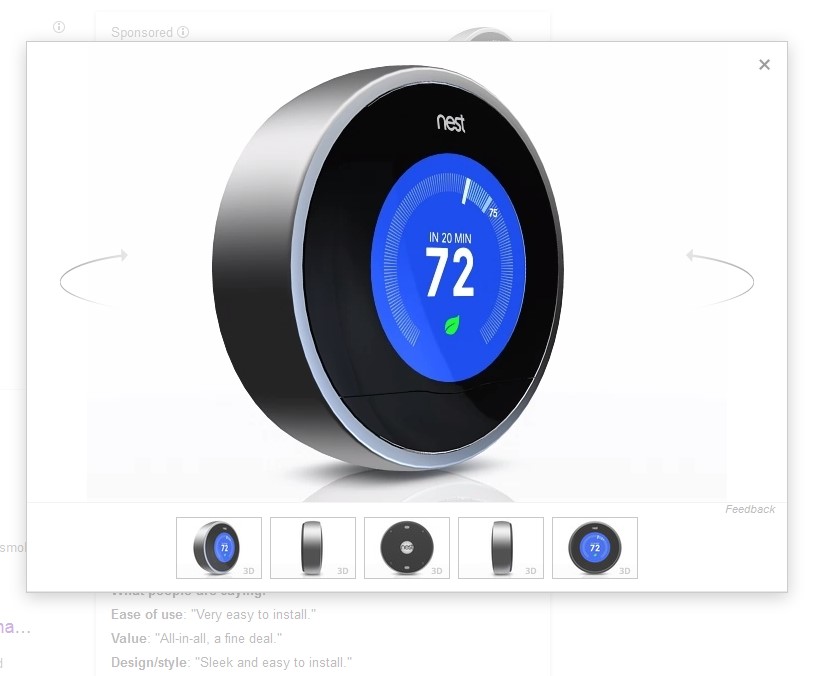
Found by Twitter user Britney Muller of Pryde Marketing, the sponsored result for “Nest thermostats” — now owned by Google — incorporates Google Shopping’s 3D product view. The result presents information from Google Shopping including a list of merchants with prices, product details and reviews all in one box in the search result.
Google Shopping New PLA Display
Clicking on the tiny “3D” icon brings up window with the full product view. Users can view each side of the product by moving it manually with their mouse or by clicking on the individual product shots.
3d Product View Google Shopping
Expanding the number of products with 3D views in Google Shopping has been a priority for the gTech Partner Solutions team which is producing the images in partnership with manufacturers. This search results presentation is likely to garner many more impressions for the 3D product views than they receive from within Google Shopping itself.
We haven’t been able to replicate this for other products yet, including other Google produced products such as Nexus and Chromebooks, but we can expect to see Google continue to experiment with incorporating more Google Shopping content into the search results.
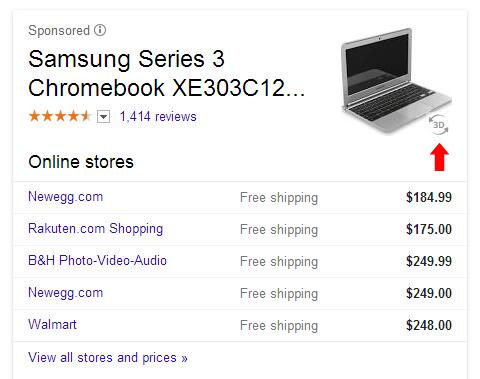
Update: I haven’t been able to replicate this, but Glenn Gabe of G-Squared Interactive spotted this version for the Samsung Series 3 Chromebook.

View image on Twitter
Here's another 3D View PLA (for the Samsung Series 3 Chromebook) http://glennga.be/1fSh7No  cc: @GinnyMarvin
read more

Thursday, 13 March 2014

Google Reviewing “Not Provided,” Withholding Keywords From Organic But Not Paid Search Clicks

No comments
not-provided-featured
When Google moved to secure search in October 2011, it was a blow to publishers, who began losing data about the search terms used to reach their sites. It also opened Google up to claims of hypocrisy, in that advertisers continued to receive the terms. Now, Google says it’s reexamining the issue and seeking a better solution.
Will clicks on non-paid listings go back to passing along search term data again? Will ad clicks have that withheld? Google didn’t say either way, and there could be other possibilities, as well.

Google Looking For Solution

The news came out of a keynote conversation with Google search chief Amit Singhalyesterday at our SMX West conference. I raised the issue of “not provided,” as it’s known as a short-hand term search marketers and many publishers in general.
I wasn’t really expecting much of an answer — in fact, I’ve written so much about the topic, with relatively little response from Google about the perceived inequities and hypocrisy, that I’ve felt like a broken record. I certainly got surprised. Singhal said:
Over a period of time, we [Google's search and ad sides] have been looking at this issue…. we’re also hearing from our users that they would want their searches to be secure … it’s really important to the users. We really like the way things have gone on the organic side of search.
I have nothing to announce right now, but in the coming weeks and months as [we] find the right solution, expect something to come out.
Here’s the complete segment. Note that references to “Sridhar” are about Sridhar Ramaswamy, who oversees Google’s ads.


Paid Clicks To Lose Terms? Organic Clicks To Get Them Back?

Google’s looking for a solution?” What’s that mean! After the talk, I saw people tweeting speculation that paid clicks might get terms withheld:
@mattcutts @larrykim - don't start messing with your paid terms now ;)
read more

Monday, 10 March 2014

Privacy Groups Want to Stall FB-Whatsapp Deal?

No comments
Privacy advocates have asked U.S. regulators to halt Facebook Inc's $19 billion acquisition of messaging service WhatsApp until there is a clearer understanding of how the company intends to use the personal data of WhatsApp's 450 million users.


WhatsApp, a service that allows mobile phone users to send each other messages, has had a longstanding commitment to not collect user data for advertising purposes.


But there's no guarantee that that commitment will hold true once the service becomes part of Facebook, according to the filing to the Federal Trade Commission by the Electronic Privacy Information Center and the Center for Digital Democracy, both non-profit groups.


The complaint asks regulators to investigate the deal "specifically with regard to the ability of Facebook to access WhatsApp's store of user mobile phone numbers and metadata."


Facebook, the world's No.1 social network with 1.2 billion users, generates the majority of its revenue by showing ads that target users by age, gender and other traits.

"As we have said repeatedly, Whatsapp will operate as a separate company and will honor its commitments to privacy and security," Facebook said in a statement in response to the filing. The FTC declined to comment.


Facebook stunned the technology industry last month when it announced its intention to buy the five-year old WhatsApp for $19 billion in cash and stock. WhatsApp does not show ads on its service, charging some of its users a $1 annual fee to use the service.

WhatsApp stores users' mobile phone numbers, but unlike many online services, it does not collect user names, emails, and other contact information.


Despite assurances by WhatsApp and Facebook that the privacy policies will not change, the groups that wrote the FTC filing note that Facebook has in the past amended an acquired-company's privacy policies, such as the Instagram photo-sharing service that Facebook acquired in 2012.


Regulators must require that Facebook "insulate" WhatsApp user information from access by Facebook's data collection practices, reads the complaint.


"WhatsApp users could not reasonably have anticipated that by selecting a pro-privacy messaging service, they would subject their data to Facebook's data collection practices," reads the filing.

REUTERS
read more

Friday, 28 February 2014

weet Showing How Google Itself Is A “Scraper Site” Goes Massively Viral

No comments
what_is_a_scraper_site_-_Google_Search-9
Perhaps it’s SEO’s “Oreo moment,” a tweet relating to search engine optimization that’s gained nearly as much attention as Oreo’s famous Super Bowl blackout tweet. But the subject was a perfect storm of goodness — a real-life example of Google doing the type of thing in search it seems to be telling others not to do.
Yesterday, the head of Google’s web spam team Matt Cutts announced a new Google Scraper Report for publishers to use if they see a site that has copied or “scraped” its content and which outranks the publisher in Google searches.
That quickly brought up a number of people joking in various places about how Google itself borrows content from other sites to make the direct answers it displays in its own search results. But, no joke hit it as right as that from digital marketer Dan Barker on Twitter, who tweeted back to Cutts:
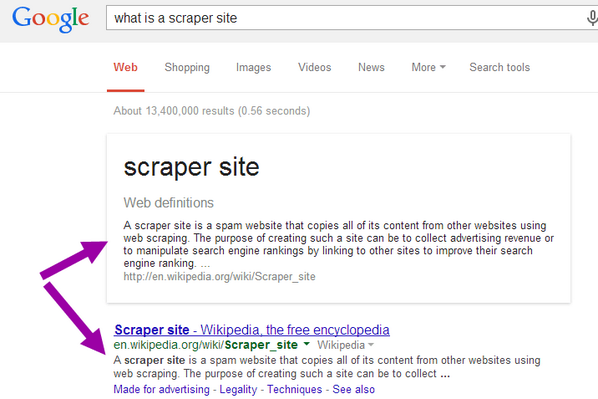
View image on Twitter
It was super clever. Barker did a search for what is a scraper site, which brought up Google’s own web definition at the top of the results. And that definition technically outranks the original source of the content, Wikipedia, which comes right below.
Google does link to Wikipedia in its excerpt, which is in keeping with how its other search results work and generally on the right side of the law, when these things have been challenged in various places. And by scraper site, Google’s really talking about sites that wholescale copy all of someone’s content, rather than aiming for a fair use excerpt.
But still, as Google has increased the amount of web definitionsdirect answers andKnowledge Graph box answers that are drawn from the content of other sites, the tensions have been rising.
With regular search listings, Google typically showed enough information for a searcher to decide if they want to visit a website and, if so, they’d click through. But the changes over the past few years (which Bing also does) have been to provide actual answers drawn from sites, so that there’s no need to click through.
It’s a difficult balancing act, because there are good reasons why it makes more sense for Google (or Bing) to just show the direct answer of something, rather than having dozens of sites all fight to be number one for “What time is the Super Bowl,” as they do.
But, it’s also a fundamental change to the unwritten contract between search engines and publishers — that yes, search engines can build their “content” on the back of publisher content, but only if there’s a fair exchange of traffic.
Barker’s tweet is perhaps the biggest sign ever that publishers are feeling like the balancing act is tipping too much into Google’s side. I’ve never, in 18 years writing about search, seen such a response like this. Last year’s Oreo tweet, when the Super Bowl had a blackout, was a darling example of huge engagement.
That tweet, associated with a prime time event, has about 16,000 retweets as of today, over a year later. Barker’s tweet, not associated with any major sporting event and about an issue that’s usually only of concern to SEOs, is over 14,000 tweets as I write this — and over 12,000 favorites.
read more

Study: Women Spotlighted In Only 17% Of Google Doodles Between 2010 & 2013

No comments
SPARK logoIn its expansive Google: Doodle Us study, female advocacy group SPARK revealed only 77 women were represented in the 445 Google Doodles featured on the site’s various country-specific homepages between 2010 and 2013.
Analyzing the individuals honored by Google logos appearing on the site’s global and regional homepages, as well as homepages for individual countries, the study concentrated on actual people, excluding any Doodles highlighting fictional characters or individuals connected to a holiday or festival.
According to SPARK:
Out of the 445 total Doodles Google created to honor people between the years of 2010 and 2013, a full 74 percent honored white people. Only 17 percent honored women of any race. And even more abysmal 4.3 percent honored women of color.
Google Doodle women vs men
In response to the study, Google Doodle team lead Ryan Germick acknowledged Google’s poor showing when it comes to spotlighting women on its homepage.
“Women have been underrepresented in history in almost all fields: science, school, curricula, business, politics – and, sadly, doodles – despite incredible contributions both directly and behind the scenes,” said Germick in an email, “We’ve been working to fix the imbalance in our doodles – this year we’re hoping to have women and men equally represented.”
Germick pointed out that his team has created as many Doodles for women as men since the start of 2014. So far this year, the US homepage has featured logos for Zora Neale HurstonDian Fossey and Harriet Tubman.
Harriet Tubman Google Logo
The underwhelming representation of women in tech is not exclusive to Google’s homepage. AWall Street Journal report on SPARK’s study noted Facebook COO Sheryl Sandberg’s calling attention to the issue in her book Lean In.
HBO was also under fire just this week when AdAge’s Simon Dumenco’s called out the cable network for its trailer promoting the new HBO show Silicon Valley, “See the Trailer for HBO’s ‘Silicon Valley’: Apparently There Are No Women in Tech (Except for Go-Go Dancers.”
In an email to Marketing Land, a Google spokesperson outlined Google’s efforts to support women. Listing initiatives like Google’s Women Techmakers interview series, the $1.2 million grant Google endowed to the Geena Davis Institute on Gender in Media, and the launching of the WeTech (Women Enhancing Technology) Fund, the Google spokesperson claimed the company is doing its part to raise the visibility of women, not only in the tech industry, but on a global level.
“We’re working with partners in education to add hands-on STEM/STEAM (Science, Technology, Engineering, Arts and Math) curriculum to schools and to encourage more girls and underrepresented minority youth to get excited about professions in technology,” said the Google spokesperson.
Beyond evaluating the number of women represented by Google Doodles, the SPARK study also tracked Google Doodle honorees by region and found an overwhelming majority were European.
Google Doodles by region
“When we look at whose stories are told in public spaces – from statues in public parks to the Google home page – it tells us who is important in the world,” said SPARK executive director Dana Edell as quoted in the Wall Street Journal report.
SPARK is asking people to raise awareness by sharing its research on social media pages using the hashtag #DoodleUs or signing its “Give Us Doodles Like Us” petition on Change.org.
read more

Thursday, 27 February 2014

Google Yanks Fake FBI Listing From Google Maps, Puts New Blocks In Place To Stop Further Abuse

No comments
google-maps-appIn response to a string of cases where fake business/organization listings have been added to Google Maps, Google says it has removed those listings and put in place new hurdles to make it more difficult for this kind of abuse to get through its system.
This latest run of problems came to light about a week ago, when some users discovered they could use Google Map Maker to create fake businesses that would be verified via a phone call. In the beginning, many of the fake listings were harmless.
More recently, the same user took advantage of Map Maker tocreate fake FBI and Secret Service office listings using his own phone number, and even managed to intercept calls to both agencies. Both of those listings were created in close proximity to actual offices, adding to the confusion over which listing was real.
google-maps-fake-fbi
Google has now removed the fake FBI and Secret Service listings, as well as others that have been exposed over the past week.
In addition, contacts at the company tell us that they’ve put new restrictions in place that will make it more difficult for this kind of activity to produce a “live” place listing on Google Maps.
This is hardly the first time users have found a hole in Google’s systems that allowed the creation of fake business listings in Google Maps. More than five years ago, for example, Danny Sullivan wrote about being able to “hijack” Yahoo’s listing and changing the company name to Microsoft.
In this latest case, though, the timing is particularly bad since Google just released its new Google Maps product out of beta.
The hole actually involved Map Maker, Google’s product that allows for crowd-sourced improvements to Google Maps. Hundreds of thousands of edits over the years have helped improve Maps, but it was also still open to the kind of exploits that have been detailed over the past week.
Given the competitive nature of local search, it probably won’t be too long before we find out if Google’s new restrictions succeed in preventing more of this kind of abuse … or if users find other holes they can exploit.
read more

Someone Outranking You With Your Own Content? Use The New Google Scraper Report

No comments
google scraper
One of the most frustrating experiences for any publisher is discovering that someone not only has copied your content but outranks you on Google for searches related to that content. Now, Google seems to have heard the complaints and has launched a tool to help.
Called the Google Scraper Report, it was announced by the head of Google’s web spam team Matt Cutts on Twitter:

If you see a scraper URL outranking the original source of content in Google, please tell us about it: http://bit.ly/scraperspamreport 


The Google Scraper Report form doesn’t promise any immediate fix — or any fix at all. Rather, it simply asks people to share their original content URL, the URL of the content taken from them and the search results that triggered the outranking.
Google does have a DMCA system that people can use to remove infringing content, but that can be a time-consuming process. Potentially, this allows Google’s spam team to move against infringing content by considering  it a spam offense, rather than a copyright issue.
There’s a slight negative in that potentially, someone reported for spamming as a “scraper” might have a valid copyright claim. But realistically, there are so many terrible scrapers out there, and the activity is often so obviously infringing, that removing such content on spam grounds would allow Google to apply more common sense to the problem, rather than virtual paperwork.
Again, however, it might be that the form won’t do any removals at all. Potentially, Google’s using it as a way just to harvest examples in order to improve its ranking system, so that original content shows up first.
read more

Google AdWords Smart Annotations Test Continues To Roll Out

No comments
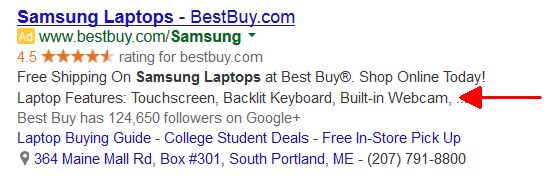
Google has been expanding testing for the new Smart Annotations over the past few weeks. Smart Annotations automatically pull information from an advertiser’s landing page in an additional line of text in their ads.
AdWords Smart Annotations laptop featuresGoogle hasn’t made an official announcement, but AdWords reps have been reaching out to notify their clients of the roll-out. Nilaye Tharkar, head of search at Performics Canada, received a heads up at the end of January about Smart Annotations testing. Here’s an excerpt from that email:
While this added line is not clickable, we saw an average CTR improvement of 9% in our pilot.
The added line comes from data we find on the landing page; it comes from navigation categories that typically are on the left side of your page (but could be elsewhere, like along the top). We look for relevancy and then typically take them in order off the landing page; respecting any trademark claims we have on file.
We expect to make basic reporting available roughly 1 month after launching (earlier data would not be statistically significant), and as always there is an opt out procedure
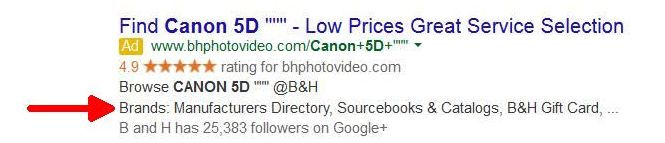
In the screenshot above, the smart annotation is pulling the list of “Laptop Features” itemized about halfway way down the left navigation on that Best Buy landing page. Often, the annotation will include a list of brands, also pulled from the left nav, as in the example below forwarded by Tharkar.
smart annotations google adwords testingHowever, in an example I found today, the smart annotation is pulling from footer content, and the user value is questionable. The colon after “Brands” in the annotation makes the listing particularly confusing.Google AdWords Smart Annotations pullinag from FooterHere’s the footer information getting pulled into this smart annotation.
Smart Annotations pulling from landing page footerThis format is still in a limited test phase, so we may see funky displays like this example to get ironed out.
Again, these extra lines of copy are getting pulled in automatically, so there is no action to take on the advertiser’s end except to opt-out if desired.
read more